7 Master Sanitation Schedule Mistakes That Cause Audit Findings
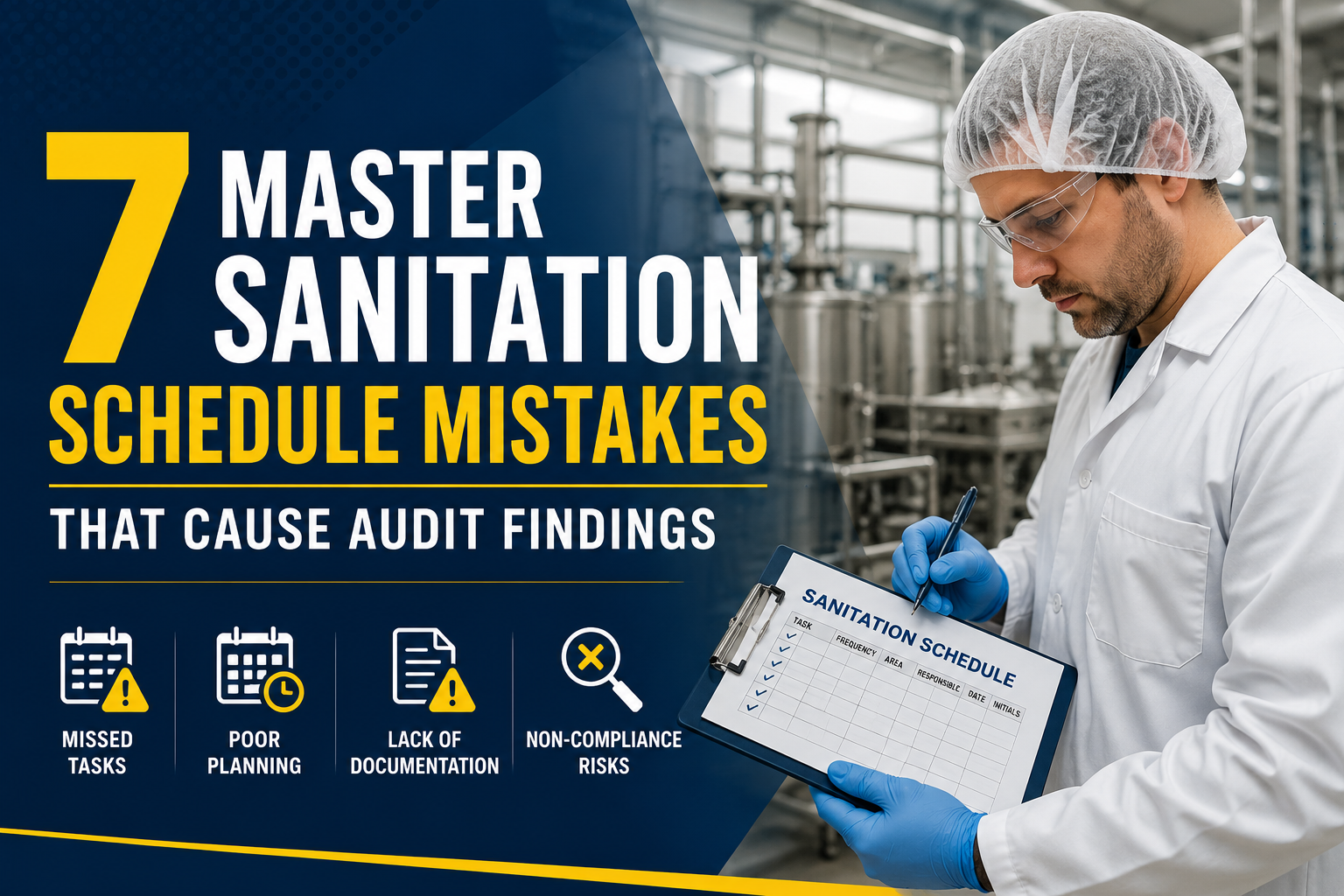
Your master sanitation schedule should tell a trained employee what must be cleaned, where it is located, how often the work is due, who owns the task, which procedure applies, and how the result will be checked.
When one of those answers is missing, the schedule may record activity without proving sanitation control. An auditor can follow that gap from the spreadsheet to the plant floor and write a finding.
Recent audit data shows why this deserves attention. In June 2026, BRCGS reported that housekeeping and hygiene was the most frequently raised non-conformity in global Food Safety Issue 9 audits conducted from April 2025 through March 2026. Common problems included complex equipment, production pressure, and infrequently visited areas that cleaning programs missed.
Key Points
- The schedule must cover the full facility, not only obvious production equipment.
- Cleaning frequency needs a documented risk basis.
- A completed task and a verified result are not the same thing.
- Missed work must remain visible and receive a documented response.
- Environmental, pre-op, allergen, maintenance, and audit data should lead to schedule changes.
What Should a Master Sanitation Schedule Prove?
A master sanitation schedule should prove that every relevant area and asset has a defined cleaning method, frequency, owner, record, and verification process. It should also show what happens when work is late, an inspection fails, equipment changes, or sanitation results begin moving in the wrong direction.
The current SQF Food Safety Code for Food Manufacturing, Edition 10 identifies cleaning and sanitation as a Core Clause.
SQF element 11.2.5.1 calls for a documented program that addresses:
- What must be cleaned
- The cleaning method
- Cleaning frequency
- Responsible personnel
- Validation of food-contact cleaning procedures
- Confirmation of detergent and sanitizer concentrations
- Verification of cleaning-program effectiveness
SQF also requires records of cleaning, sanitation, pre-operational inspections, and verification activities. During an audit, the auditor may review records, interview employees, and observe cleaning activities across shifts.
For FDA-regulated food facilities, 21 CFR 117.35 requires plant facilities to be maintained in clean and sanitary condition. It also requires food-contact and non-food-contact surfaces to be cleaned at frequencies that protect food, packaging, and food-contact surfaces from contamination and allergen cross-contact.
USDA-regulated establishments should also connect the MSS to their written Sanitation SOP system. Under 9 CFR Part 416, Sanitation SOPs must identify frequencies and responsible employees, be reviewed when plant conditions change, and have records showing implementation, monitoring, and corrective action.
These requirements create a simple audit test:
| The auditor asks | Your program should show |
| What is being cleaned? | A specific asset, part, structure, or area |
| Why this frequency? | A documented risk and data basis |
| How is it cleaned? | A current SSOP or work instruction |
| Who performs the work? | A trained role with clear accountability |
| Was it completed on time? | A dated, traceable record |
| Did the cleaning work? | Defined verification and acceptance criteria |
| What happened after failure? | Correction, root cause, follow-up, and review |
Mistake 1: Important Areas Are Missing From the Schedule
One of the fastest ways to receive a finding is to leave cleanable assets outside the program.
Many schedules cover mixers, fillers, conveyors, tables, and packaging equipment. They do not always cover the equipment framework, conveyor undersides, overhead pipes, fan guards, evaporators, wall-to-floor joints, electrical conduit, door tracks, hose stations, docks, mezzanines, drains, utility rooms, or maintenance access points.
The current SQF Code specifically calls attention to walls, ceilings, doors, drains, pipes, ducting, platforms, lighting structures, ventilation equipment, staff areas, conveyors, containers, equipment, and utensils.
Why Auditors Write the Finding
An auditor does not review the schedule only from a desk. The auditor walks the building and compares actual plant conditions with the written program.
A dirty pipe support or fan guard can lead to questions such as:
- Is this item on the schedule?
- When was it last cleaned?
- Which procedure applies?
- Who checked the result?
- Are similar items also missing?
One missed structure can reveal that the facility never completed a full sanitation inventory.
How to Correct It
Map the plant by:
- Room
- Production line
- Equipment system
- Sanitation zone
- Elevation
- Utility or support area
Walk the site with sanitation, QA, maintenance, and operations. Each department sees different risks.
Include equipment parts that become visible only after teardown. Also include idle equipment, temporary equipment, seasonal lines, construction changes, and assets above or beside exposed product.
Do this: Identify “overhead pipe supports above Packaging Line 2.”
Not this: Write “clean overheads.”
Mistake 2: Frequencies Are Based on the Calendar, Not Risk
Weekly, monthly, quarterly, and annual frequencies may look organized. The problem starts when no one can explain why a task belongs at that interval.
A frequency should reflect what happens at that location.
Consider:
- Food-contact or non-food-contact status
- Proximity to exposed product
- Wet, dry, or low-moisture conditions
- Soil type and buildup rate
- Allergen exposure
- Condensation
- Production hours
- Equipment design
- Employee and forklift traffic
- Historical pre-op findings
- ATP, allergen, or microbiological results
- Maintenance history
- Seasonal conditions
For example, a quarterly frequency may have worked when a line operated three days per week. It may no longer fit after production moves to six days per week.
What Evidence Should Support the Frequency?
Keep a brief frequency basis with each major task or task group.
| Risk level | Possible frequency basis |
| Higher-risk food-contact component | Product exposure, allergen risk, clean-break validation, operating hours |
| Zone 2 or close non-contact surface | Transfer risk, moisture, traffic, environmental history |
| Zone 3 floor, drain, or framework | Soil load, water movement, employee traffic, trend results |
| Remote overhead or utility area | Dust, condensation, maintenance access, product exposure below |
| Warehouse or dock structure | Traffic, pests, weather exposure, damaged packaging risk |
The frequency does not need to be permanent. It needs to be supported.
When results show the interval is too long, shorten it. When enough data shows an interval can safely change, document the review before changing the schedule.
Mistake 3: The Task Description Is Too Vague to Repeat
“Deep clean filler.”
“Clean drains.”
“Wash walls.”
These instructions may fit inside a spreadsheet cell, but they do not tell the employee what good work looks like.
Two employees can complete the same vague task in different ways. One removes guards and cleans hidden product buildup. The other cleans only the visible exterior. Both may initial the same record.
What the Task Should Include
The MSS does not need to hold the full cleaning procedure. It should point to a current SSOP or work instruction that covers the necessary details.
Depending on the task, the procedure may address:
- Required shutdown or lockout steps
- Safe access
- Equipment disassembly
- Removal of gross soil
- Dry-cleaning or wet-cleaning method
- Approved tools
- Detergent and sanitizer
- Concentration
- Water temperature
- Contact time
- Rinsing
- Drying
- Reassembly
- Inspection points
- Release criteria
For clean-in-place systems, SQF Edition 10 calls for critical CIP parameters—such as chemical, concentration, contact time, and temperature—to be defined, monitored, and recorded.
Check the Link, Not Just the Number
A schedule may reference “SSOP-014,” but the link can still fail when:
- The SSOP was retired
- The equipment was modified
- The procedure uses an old chemical
- The document does not include a newly added guard
- Employees cannot access the current version
- The schedule and procedure use different equipment names
Select several MSS lines and confirm that each one leads to the correct current procedure.
Mistake 4: Ownership Is Assigned to a Department Instead of a Role
“Sanitation” is not always a clear task owner.
Neither is “maintenance,” “production,” or “contractor.”
When a task requires several departments, unclear ownership creates missed work and incomplete records.
Consider an overhead cleaning task:
- Maintenance provides access and protects electrical components.
- Sanitation performs the cleaning.
- Maintenance reassembles or removes access equipment.
- QA completes the post-clean inspection.
- Production confirms the area is ready before startup.
If the schedule lists only “sanitation,” the handoffs remain undocumented.
What Auditors May Ask Employees
An auditor may ask:
- Which MSS tasks do you own?
- How do you know when a task is due?
- Which procedure do you follow?
- What do you do if you cannot access the area?
- Who reviews the work?
- What happens when the inspection fails?
SQF’s March 2026 environmental-monitoring guidance describes an audit approach built around records, interviews, and observations. It identifies sanitation, QA, production, maintenance, technical leaders, and management as personnel who may be interviewed.
Assign:
- One accountable role
- Supporting roles
- A backup role
- A verifier
- An escalation path
Training records should match the procedures and tasks each role performs.
Mistake 5: Records Hide Missed, Late, or Incomplete Work
A row of checkmarks may look clean, but perfect records can create more questions when plant conditions tell a different story.
Weak MSS records often contain:
- Initials without a date or time
- Several weeks signed at once
- No distinction between complete and inspected
- No record of inaccessible areas
- Due dates changed after work was missed
- Blank lines with no explanation
- “N/A” used without approval
- No record of recleaning
- No link to a work order or corrective action
Use Statuses That Tell the Truth
| Status | Required information |
| Completed | Date, time, performer, and applicable result |
| Completed late | Original due date, completion date, reason, and approval |
| Deferred | Reason, risk review, temporary control, new date, and owner |
| Unable to access | Access problem, escalation, interim control, and reschedule date |
| Failed verification | Finding, correction, reinspection, and final disposition |
| Removed from service | Asset status, approval, and schedule update |
Do not erase a missed task by moving its original due date.
A credible record shows what happened. It also shows how the plant controlled any risk created by the delay.
Current SQF Edition 10 gives extra weight to core clause findings. A regular minor non-conformance carries a one-point deduction, while a core clause minor carries two points. A regular major carries five points, while a core clause major carries seven. Cleaning and sanitation are identified as core clauses.
Mistake 6: A Signature Is Treated as Verification
The employee’s signature confirms that the employee recorded the task as complete.
It does not automatically prove that the surface was clean, the sanitizer was mixed correctly, allergen residue was removed, or microbial control was effective.
Verification needs a separate purpose, method, person, and acceptance limit.
Verification May Include
- Visual post-clean inspection
- Pre-operational inspection
- ATP testing
- Protein or allergen residue testing
- Sanitizer concentration measurement
- Microbiological indicator testing
- Environmental pathogen monitoring
- CIP record review
- Record and trend review
The right method depends on the task and risk.
A visual inspection may be suitable for dust on a remote overhead. It is not enough by itself to confirm that an allergen-cleaning procedure removed target residue from a food-contact surface.
FDA’s January 2025 draft guidance for low-moisture ready-to-eat foods specifically discusses routine sanitation, environmental monitoring, root-cause investigation, corrective action, and the limitations of relying only on finished-product testing after a pathogen event.
Completion Versus Verification
| Completion record | Verification record |
| Who performed the task | Who checked the result |
| When the work occurred | When the check occurred |
| Procedure used | Verification method |
| Task status | Acceptance criteria |
| Exceptions noted | Pass, fail, or investigation result |
| Employee authentication | Verifier authentication |
Where independence is practical, the person checking the work should not be the same person who performed it.
Mistake 7: The Schedule Does Not Change When the Plant Changes
A master sanitation schedule is not finished when the spreadsheet is approved.
Plant conditions keep changing:
- Equipment is installed or moved
- Guards and framework are modified
- Production volume increases
- New products introduce allergens
- Repairs create new seams or access points
- Drainage patterns change
- Roof or pipe leaks add moisture
- Environmental results show repeated activity
- Pre-op findings appear in the same location
- Construction creates dust or debris
- Temporary repairs remain in place
Each event should trigger a review of affected tasks, methods, frequencies, training, and verification.
For USDA-regulated establishments, 9 CFR 416.14 requires routine evaluation of Sanitation SOP effectiveness and revisions when facilities, equipment, utensils, operations, or personnel change.
SQFI’s 2026 environmental-monitoring guidance also describes an EMP as a verification system for cleaning and sanitation. It calls for risk-based sampling, trend evaluation, corrections, corrective actions, and preventive-action follow-up. The guidance states that an ineffective EMP without a supporting risk assessment may result in a major non-conformance.
A Current Regulatory Example
In a March 3, 2026 warning letter, FDA reported inspecting four seafood-processing facilities and finding Listeria monocytogenes in environmental samples from three of them.
The FDA also described sanitation-control concerns, recurring conditions across locations, and missing documentation needed to support corrective actions. The letter shows why cleaning records, environmental results, training, root-cause work, and program changes must tell one consistent story.
How Do You Review a Master Sanitation Schedule Before an Audit?
Use a floor-to-record trace. Do not limit the review to proofreading the spreadsheet.
Step 1: Select Representative Tasks
Choose at least five tasks:
- A high-risk food-contact task
- An overhead or hard-to-access task
- A drain or floor task
- A task that was recently late or failed
- A task affected by maintenance or construction
Step 2: Trace Each Task Through the System
For each task, review:
- MSS entry
- Risk-based frequency
- Current SSOP
- Employee training
- Completion record
- Verification record
- Corrective action, when applicable
- Schedule revision history
Step 3: Walk to the Asset
Confirm that:
- The asset name matches the schedule
- All components are included
- The condition matches the latest record
- Access is practical
- Tools and chemicals match the procedure
- No nearby asset has been left outside the program
Step 4: Interview the Assigned Employee
Ask the employee to explain the task in their own words.
Do not coach the answer.
Confirm that the employee knows:
- When the task is due
- Which procedure applies
- What chemicals and tools are allowed
- What acceptable cleaning looks like
- How to report a delay or failure
Step 5: Test the Failure Path
Choose one failed pre-op, ATP result, allergen result, environmental finding, or overdue task.
Trace it through:
- Immediate correction
- Product or area assessment
- Root-cause review
- Corrective action
- Reinspection or retesting
- Preventive action
- MSS or SSOP revision
If the investigation stops at “recleaned and passed,” the plant may have corrected the condition without addressing why it happened.
Master Sanitation Schedule Pre-Audit Checklist
Use this checklist before an internal, customer, regulatory, SQF, BRCGS, or FSSC 22000 audit.
Scope
- Every room and production area has been reviewed.
- Overheads, drains, framework, utilities, docks, and support areas are covered.
- New, temporary, seasonal, and idle equipment has been assessed.
- Food-contact and non-food-contact components are clearly identified.
Frequencies
- Frequencies have a documented risk basis.
- Production hours and soil buildup have been considered.
- Environmental, pre-op, ATP, and allergen trends have been reviewed.
- Frequency changes are approved and traceable.
Procedures
- Every MSS task links to a current SSOP or instruction.
- Procedures match the equipment currently on the floor.
- Chemical, concentration, contact-time, access, and drying details are current.
- Controlled copies are available to the employees doing the work.
People and Records
- Each task has one accountable role.
- Department handoffs are documented.
- Assigned employees have current training.
- Records show actual dates, times, statuses, and exceptions.
- Overdue work remains visible.
Verification and Follow-Up
- Verification is separate from task completion.
- Acceptance criteria are written.
- Failures receive correction and root-cause review.
- Recleaning and reinspection records are linked.
- Trends lead to MSS, SSOP, training, or maintenance changes.
How Sani Process Control Can Help
A master sanitation schedule should work during production pressure, staff changes, maintenance activity, and unannounced audits, not only when the document is reviewed in a conference room.
Sani Process Control helps food manufacturers connect sanitation planning, plant-floor work, records, verification, and follow-up.
Support can include:
- Sanitation consultation and MSS development
- Facility and sanitation risk assessments
- SSOP review and development
- Risk-based cleaning-frequency review
- Task ownership and handoff planning
- Audit preparation and gap assessments
- Environmental monitoring and trend review
- Master sanitation cleaning services
Sani Process Control describes its work as sanitation support built for food manufacturers, processors, and packing facilities, with services covering food plant sanitation, process control, audit preparation, training, environmental monitoring, and facility-specific sanitation programs.
Final Takeaway
Most master sanitation schedule findings are not caused by a missing spreadsheet.
They happen because the written program and the plant floor do not match.
A strong schedule identifies the full scope, assigns practical frequencies, links each task to a usable method, gives ownership to trained roles, records what actually occurred, and checks whether the cleaning worked.
Review your master sanitation schedule the same way an auditor will: through records, employee interviews, and direct observation.
Need Help Reviewing Your Sanitation Program?
You may already know that your schedule needs work but still need to identify which gaps create the greatest food-safety or audit risk.
Sani Process Control can review your MSS, SSOPs, sanitation records, verification methods, employee responsibilities, and plant-floor execution.
Request a free sanitation consultation or call 1-888-859-7264 to discuss the areas that should be corrected first.
FAQs
What Is a Master Sanitation Schedule?
A master sanitation schedule is the facility-wide plan for cleaning equipment, structures, utilities, and areas at defined frequencies. It states what must be cleaned, when the task is due, who owns it, which procedure applies, how completion is recorded, and how effectiveness is checked.
What Information Should Be Included in an MSS?
Include the asset or area, exact location, cleaning frequency, responsible role, linked SSOP, completion status, date, employee authentication, verification method, verifier, acceptance criteria, and response to late work or failed results.
What Is the Difference Between an MSS and an SSOP?
The MSS controls what work is due, where it occurs, how often it happens, and who owns it. An SSOP provides the detailed cleaning instructions, including preparation, disassembly, tools, chemicals, concentrations, contact times, rinsing, drying, inspection, and release requirements.
How Should MSS Cleaning Frequencies Be Set?
Set frequencies from risk and plant data. Consider product exposure, sanitation zone, soil buildup, moisture, allergens, operating hours, equipment design, pre-op findings, environmental results, maintenance history, and seasonal conditions. Record the reason behind each important frequency.
Who Should Be Responsible for the Master Sanitation Schedule?
A designated management or technical role should control the schedule. Individual tasks should be assigned to specific operational roles. Sanitation, QA, maintenance, production, and contractors may share work, but each handoff and final accountability point should be documented.
Can a Missed MSS Task Be Rescheduled?
Yes, but the original missed status should remain visible. Record why the work was delayed, assess the food-safety risk, apply temporary controls where needed, assign a new date, obtain approval, and document completion and verification.
Does Signing a Cleaning Record Count as Verification?
No. A signature can confirm that someone recorded the task as complete. Verification separately checks whether the cleaning met its acceptance criteria through methods such as visual inspection, pre-op inspection, ATP, allergen testing, sanitizer checks, microbiological testing, or record review.
How Often Should a Master Sanitation Schedule Be Reviewed?
Review the full schedule at a defined interval and whenever conditions change. Common triggers include new equipment, construction, repairs, new allergens, increased production, repeated pre-op failures, environmental trends, water events, audit findings, or changes in personnel and cleaning methods.
What MSS Records Do Auditors Usually Review?
Auditors may review the schedule, linked SSOPs, risk assessments, employee training, task-completion records, pre-op results, chemical checks, verification results, late-task approvals, corrective actions, trend reports, maintenance records, and schedule revisions.
Can Sani Process Control Review an Existing MSS?
Yes. Sani Process Control offers sanitation consultation and audit-preparation support that can help identify missing assets, weak frequencies, unclear ownership, documentation gaps, and breaks between written procedures and floor execution.